"Bonaire is to conservation as Greenwich is to time." - Captain Don Stewart, pioneering marine conservationist
Bonaire's pristine reefs and diverse marine life are unique to the Caribbean. Because the waters around Bonaire are designated as an official marine park, diving Bonaire is like diving the Caribbean the way it used to be - untouched and unspoiled. The island's location in the south Caribbean gives it an arid climate with little rainfall; consequently, the waters are exceptionally clear of silt, calm, and divable year round. It is an ideal destination for underwater photographers. Water temperatures average a warm 78-84°F (25.6-28.9°C), with visibility often averaging over 100 feet(30m), and frequently, up to 150 feet (55m). During January and February divers may wish to consider a Caribbean dive hood or 3mm shorty to conserve body heat.
Bonaire Marine Park
History:
In 1961, while most places were still nailing turtle shells to the wall and slurping turtle soup, Bonaire was enacting legislation to protect sea turtle eggs and nests. In 1971, at a time when divers carried spear guns in much the same way that they today tote underwater cameras, Bonaire banned spearfishing from its reefs. In 1975, the island made it illegal to break coral, take it from the water, or sell it--activities that are still practiced today in the Indo-Pacific. It was no wonder, then, that the government of Bonaire decided to create the Bonaire Marine Park, the next logical step in the island's conservation efforts. With the generous financial support of the World Wildlife Fund of Holland, the Marine Park was established in 1979 . Its purpose is to ensure that Bonaire's marine resources-its magnificent coral reefs, seagrass beds and mangroves-remain intact so that everyone can enjoy our wonderful coral reefs for years to come, just as they are now.
Exploring the Marine Park:
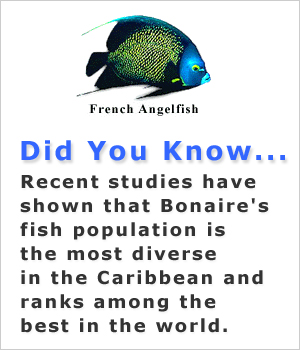
The Marine Park encompasses approximately 2700 hectares and extends all the way around Bonaire, from the high water mark to the 60m depth contour. Bonaire's narrow, fringing coral reefs encircle both Bonaire and Klein Bonaire. The reefs are very well preserved, very diverse, and support a truly amazing array of reef fish. Recent studies by Dr. Callum Roberts and the volunteer group REEF have shown that Bonaire's fish population is the most diverse in the Caribbean and ranks among the best in the world.
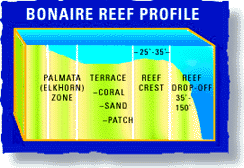
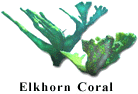
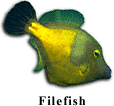
Typically, the reefs start right at the water's edge and shelve off gently to a depth of about 32 feet (10m). This area, known as the reef terrace, is very narrow along the north coast (as little as 20m wide) and much wider in the south, where it may reach widths of 200m. In very shallow waters are encrusting coral formations, which grow close the bottom to avoid wave action. On the reef terrace, you will find amazing stands of elkhorn and staghorn coral, often with fire coral, patch reefs, and dense stands of soft corals--all inhabited by a dazzling spectrum of reef fish. The tangs and parrot fish will be out in force, grazing and keeping the algae stands under control. Expect to see lots of damsel fish, with butterfly and angel fish amid grunts, coneys, rock hinds and their relatives--goatfish, hogfish, and an abundance of wrasse. On the bottom, look for peacock flounder, lizard fish, and scorpionfish, all of which are so well camouflaged that you may easily overlook them. Goatfish, by comparison, are hard to miss. They make no attempt to hide their presence as they churn up the bottom in search of tasty morsels. Be sure to notice the sticky tentacled anemones hiding within the coral.
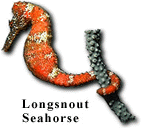
Then comes a transition to a zone dominated by the mountainous star coral, which may form huge pagoda-like structures, pillars, mounds, or even sloping, overlapping, shingle-like structures. This zone is known as the drop-off zone, and it starts almost uniformly between 10-12m. There may be an abundance of soft corals and beautifully colored sponges, as well as Byzantine stands of mountainous star coral interspersed with clouds of radiant fish. Don't miss the fierce sergeant major fish (they are actually harmless and approximately 8 inches in length) defending their eggs, and moray eels hiding out in crevices. Solitary grouper, large parrotfish, and various snapper can be seen swimming the reef; you can also expect to see the ubiquitous shoaling chromis, bothersome yellowtail snapper, and passing schools of various jacks cruising by in blue water. Specials include tarpon, turtle, seahorses and frogfish. Extra-specials are nurse shark, whale shark, rays and dolphin.
Below the drop-off, the reefs descend sharply, and the mountainous star coral communities described above yield to leaf or scroll corals, which cover the sloping bottom like a beard. This area, known as the reef slope, is also where you will find fine stands of black coral. Beware, the reefs on Bonaire slope down and down and down. The fish here are similar to, but less abundant than, those in the drop-off zone.
Bonaire also has some special reef features, including two examples of spur and groove formations, where the corals form fingers which protrude perpendicular to the shore. Typically, coral formations follow the contours of the coast. Bonaire's reef forms also include buttress formations, where corals have grown out to sea, forming a kind of headland with sandy valleys in between; a very well developed double reef in the south; and several small wall dives. Bonaire also has several large and small wrecks-the most famous is the Hilma Hooker, a freighter which lies on its side at a depth of 30m.
Park Management:
The park is managed by STINAPA, a non-governmental, not for profit organization run by a board of dedicated local professionals who donate their time to protect and conserve the island's natural flora and fauna. In addition to the Marine Park, STINAPA also manages Washington Slagbaai National Park, the Barcadera cave system, RAMSAR sites and Klein Bonaire. The park's staff of twenty-six has a BIG agenda. More than and 60,000 visitors annually keep the personnel very busy.
PARK RULES:
Please make sure that you follow our park rules and report any infringements you may see.
No anchoring. Anchoring is prohibited everywhere!
Public moorings may be used by any vessel up to 38' on first come, first serve basis for up to two hours. You MUST put out a scope line which is as long as your vessel.
Spear fishing is completely prohibited.
Do not take anything out of the water (except garbage).
Divers and snorkelers should make as little contact with the reefs as possible: don't sit, stand or hold on to coral.
Divers should make sure they are neutrally buoyant and stow gloves.
Do not take any corals, sea fans, shells or the like out of Bonaire.
Turtles are completely and internationally protected. Do not be tempted to buy shells or other turtle by-products or you will be fined heavily!
Conch are also internationally protected. Taking back one shell may cost you dearly.
Contact the Bonaire Marine Park to report any infringements at tel: 717 84444
Usage Fees
STINAPA has instituted usage fees designated to help preserve and protect the Bonaire National Marine Park. Divers are charged a US$25 fee, good for a year while windsurfers and kiteboarders pay a US$10 fee. These tags are usually available at the island's outfitters, activity operators and most hotels. The dive tags and receipt also allow free access to Washington Slagbaai National Park--always worth a visit.
Mooring Fees
Since November 1, 1999, yachts arriving on Bonaire do not have to play "musical moorings" when they make landfall. On that date, the Harbour Village Marina began managing the 40 visiting yacht moorings owned by the Bonaire Marine Park. Moorings are assigned by the Marina and can be arranged in advance by VHF. Arriving vessels proceed to the arrival dock at the Marina, clear the port authority, customs and immigration there, be given information on the Marine Park regulations, then proceed to their designated mooring.
Harbour Village Marina manages the moorings in the bay off Kralendijk. These are available, at $10 per night, to visiting yachts no more than 18 meters.
Under its contract with STINAPA, Harbour Village Marina will also be responsible for maintaining the moorings. New mooring lines have been installed, and the Marina says it intends to replace the PVC spars with something more suitable. As in the past, no liability for loss or damage will be assumed by STINAPA or the Marina. Captains will be responsible for checking the mooring lines to make sure their boat is secure. They are also responsible for leaving the mooring during adverse weather conditions, such as the heavy wave action caused by the recent westerly.
Private and Commercial Moorings
Private or commercial moorings require a permit. The cost is $ 280 per year per mooring. Moorings may be used to tie off boats, floats, swim platforms or for swim lines etc.
Fishing boats, registered with the Harbormaster, 12 feet or shorter, with a maximum 25 hp engine, are exempt from the yearly fee.
Finally, please be sure to take all your garbage home with you from your outings. Our motto is "tene Boneiru limpi" (Keep Bonaire clean).
RESEARCH
Trying to run a marine park without information on reef conditions would be like trying to run a business without any bookkeeping! We collect all kinds of information, including boat diving statistics and a running log of all visiting pleasure craft, and we have established a monitoring program evaluates long-term reef changes. With the help of a bunch of amazingly enthusiastic and dedicated volunteers, we've mapped the distribution of a colonial ascidian which seems to be causing some problems on the reef. We have conducted preliminary diver impact surveys, taken our first fish census, and collected data on fish spawning-and there's much more to come.







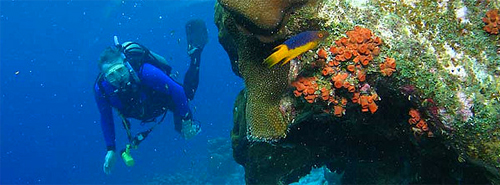

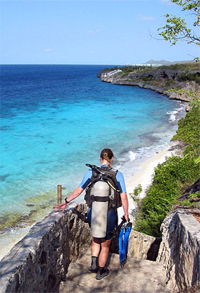 Bonaire's pristine reefs and diverse marine life are unique to the Caribbean. Because the waters around Bonaire are designated as an official marine park, diving Bonaire is like diving the Caribbean the way it used to be - untouched and unspoiled. The island's location in the south Caribbean gives it an arid climate with little rainfall; consequently, the waters are exceptionally clear of silt, calm, and divable year round. It is an ideal destination for underwater photographers. Water temperatures average a warm 78-84°F (25.6-28.9°C), with visibility often averaging over 100 feet(30m), and frequently, up to 150 feet (55m). During January and February divers may wish to consider a Caribbean dive hood or 3mm shorty to conserve body heat.
 In 1961, while most places were still nailing turtle shells to the wall and slurping turtle soup, Bonaire was enacting legislation to protect sea turtle eggs and nests. In 1971, at a time when divers carried spear guns in much the same way that they today tote underwater cameras, Bonaire banned spearfishing from its reefs. In 1975, the island made it illegal to break coral, take it from the water, or sell it--activities that are still practiced today in the Indo-Pacific. It was no wonder, then, that the government of Bonaire decided to create the Bonaire Marine Park, the next logical step in the island's conservation efforts. With the generous financial support of the World Wildlife Fund of Holland, the Marine Park was established in 1979 . Its purpose is to ensure that Bonaire's marine resources-its magnificent coral reefs, seagrass beds and mangroves-remain intact so that everyone can enjoy our wonderful coral reefs for years to come, just as they are now.
 The Marine Park encompasses approximately 2700 hectares and extends all the way around Bonaire, from the high water mark to the 60m depth contour. Bonaire's narrow, fringing coral reefs encircle both Bonaire and Klein Bonaire. The reefs are very well preserved, very diverse, and support a truly amazing array of reef fish. Recent studies by Dr. Callum Roberts and the volunteer group REEF have shown that Bonaire's fish population is the most diverse in the Caribbean and ranks among the best in the world.
 beautifully colored sponges, as well as Byzantine stands of mountainous star coral interspersed with clouds of radiant fish. Don't miss the fierce sergeant major fish (they are actually harmless and approximately 8 inches in length) defending their eggs, and moray eels hiding out in crevices. Solitary grouper, large parrotfish, and various snapper can be seen swimming the reef; you can also expect to see the ubiquitous shoaling chromis, bothersome yellowtail snapper, and passing schools of various jacks cruising by in blue water. Specials include tarpon, turtle, seahorses and frogfish. Extra-specials are nurse shark, whale shark, rays and dolphin.
 Below the drop-off, the reefs descend sharply, and the mountainous star coral communities described above yield to leaf or scroll corals, which cover the sloping bottom like a beard. This area, known as the reef slope, is also where you will find fine stands of black coral. Beware, the reefs on Bonaire slope down and down and down. The fish here are similar to, but less abundant than, those in the drop-off zone.
 Bonaire's reef forms also include buttress formations, where corals have grown out to sea, forming a kind of headland with sandy valleys in between; a very well developed double reef in the south; and several small wall dives. Bonaire also has several large and small wrecks-the most famous is the Hilma Hooker, a freighter which lies on its side at a depth of 30m.